

CIC Institute (Headquarters: Minato-ku, Tokyo; CEO: Denise Medlenka) manages “Global CityTech Bridge,” a program commissioned by the Tokyo Metropolitan Government as part of the “Project for Creating Clusters to Challenge Global Innovation.” Today, we are proud to announce that one of the projects supported by this program has successfully moved from concept to social implementation.
This demonstration project leveraged “matinno,” a sustainable building material platform provided by NewNormDesign, to create a circular interior design using materials repurposed from Expo 2025 Osaka, Kansai, Japan (following their approximately six-month use). The installation was completed at “Alcazar” (Ebisu, Shibuya-ku, Tokyo), owned by Sapporo Real Estate Development Co., Ltd., with construction executed by Semba Corporation.
This case marks a significant milestone as it managed not only the matching of reusable materials but also the end-to-end logistics coordination and environmental impact data calculation. It demonstrates that an AI-powered startup product can navigate complex stakeholder structures to move beyond a mere “test” and establish a repeatable upcycling methodology. This is a vital first step toward realizing a circular economy in the construction material industry.
Global CityTech Bridge remains committed to fostering collaborations between startups and social implementation partners to solve critical challenges such as decarbonization and resource circulation.
Project Presentation Event: Detailed project insights will be shared on Monday, March 2, at 17:00 at CIC Tokyo.
We are continuously seeking corporations and startups to join this initiative. Interested parties are encouraged to contact the execution committee.(contact : catapult@cic.com)
◾️Project Overview:
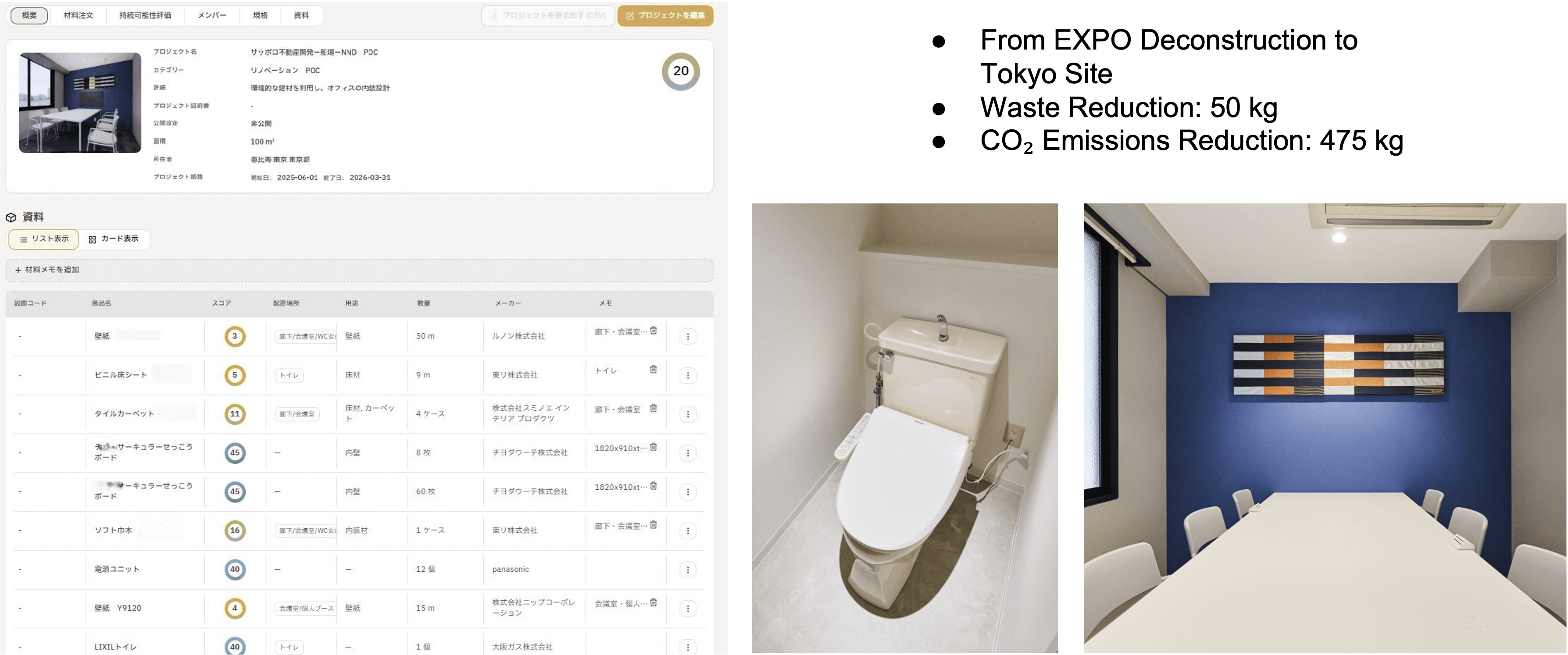
NewNormDesign Inc., in collaboration with Sapporo Real Estate Development Co., Ltd. and Semba Corporation, utilized the sustainable building material platform “matinno” to procure materials and execute sustainable interior design. By sourcing interior materials with a low environmental footprint, the project contributed to significant CO₂ reductions.
◾️Results and Social Impact:
Matinno executed the reuse of materials used for approximately six months at Expo 2025 Osaka, Kansai, Japan for an office renovation project in Ebisu, Tokyo. Despite a demanding schedule where demolition and construction occurred consecutively, the platform ensured quality and timely delivery through pre-matching. The project achieved a CO₂ reduction of approximately 475kg and a significant decrease in construction waste, proving the viability of circular architecture in real-world scenarios.
◾️Partner Comments
NewNormDesign
This is Japan’s first PoC aimed at the ‘direct transfer from demolition to construction’ from a short-term event. Matinno played the role of matching users with reused materials, establishing a proprietary map-tracking method to monitor material location and status in real-time. By providing end-to-end support—from logistical coordination to environmental impact calculations—we have built the foundation for clients who previously lacked reuse expertise to confidently choose upcycling for their next projects.
In addition, the MVP of “matinno” was officially launched on January 28, 2026, and is currently accepting free applications from manufacturers who wish to have their materials evaluated and introduced to designers.
Applications: www.matinno.co
Sapporo Real Estate Development Co., Ltd.
In the renewal of our property’s units, we adopted sustainable interiors and materials via NewNormDesign’s ‘matinno.’ This allowed us to successfully balance environmental impact reduction with the enhancement of the property’s value.
Semba Corporation
Semba, a spatial design and construction company creating environments for commercial facilities as well as offices, educational institutions, healthcare facilities, and leisure spaces, has been a pioneer in promoting circular and ethical design practices within the interior construction industry.
In this project, Semba utilized the sustainable building materials platform “Matinno” to reuse building materials and fixtures previously used at the Expo, and was responsible for the design and delivery of a setup office space for Sapporo Real Estate Development. In addition, Semba provided a database of design and construction data from this project and participated as a test case for the implementation of the service.
Through this initiative, it became possible to quantitatively assess the impact of environmental load reduction—one of the long-standing challenges in the interior construction industry—by enabling the optimal selection of building materials and fixtures. As a result, the use of reused materials and ethical materials has been effectively promoted.
Aimed at fostering innovation and social implementation of CityTech (urban-related technology). Operated jointly by CIC Institute and Shimizu Corporation, it partners with 18 corporations/municipalities and international entities like Connected Places Catapult (UK) and Anywhere Ventures (USA). The program provides startups with matchmaking, pilot opportunities, financial support, and global expansion assistance.
More Details on Global CityTech Bridge:https://jp.cic.com/tib-catapult/

As part of the Tokyo Metropolitan Government’s goal to become the “world’s most startup-friendly city,” TIB CATAPULT was launched to create “clusters” of business entities and startups to solve global issues.
More Details on TIB CATAPULT (Website of Tokyo Metropolitan Government):https://tibcatapult.metro.tokyo.lg.jp/
The specialized consulting arm of CIC (Cambridge Innovation Center), which operates innovation centers globally. Leveraging expertise in building innovation ecosystems and supporting deep-tech startups, CIC Institute works with governments, universities, and corporations to facilitate global startup growth.
More Details on CIC Institute:https://jp.cic.com/innovation-program/#about-cic-institute
Global CityTech Bridge Committe :Kagami, Enkhtur, Ikemoto ( catapult@cic.com )